The short answer is yes, historically. Open-market insider buying is one of the few signals that has held up across decades of academic research. But the honest answer has an asterisk: not all insider buying is bullish, and most of what gets reported as a "buy" is noise. The edge lives in a specific subset of purchases, and knowing how to separate the two is the whole game.
Here is why the signal exists, what the research shows, and how to tell a meaningful buy from a meaningless one.
WHY INSIDER BUYING MEANS SOMETHING
There is an old line, usually attributed to Peter Lynch, that captures it: insiders sell their own stock for all kinds of reasons, but they buy it for only one. A CEO might sell to buy a house, diversify, pay taxes, or fund a divorce. None of that tells you anything about the company. But when that same CEO takes personal, after-tax cash and puts it back into their own stock on the open market, there is really only one explanation. They think it is going higher.
That asymmetry is the entire foundation of the signal. Insiders know their order book, their pipeline, their margins, and their competitive position better than any analyst or algorithm ever will. When they put money down, they are voting with the best information available.
The key phrase is "open-market." A purchase only carries information if the insider chose to make it with their own cash at the market price. Shares handed out as compensation, options exercised at a fixed strike, or automatic plan purchases do not carry the same signal, even though filings lump them together.
WHAT THE RESEARCH SHOWS
Studies going back to the 1970s, and revisited many times since, consistently find that stocks with recent open-market insider purchases generate statistically significant excess returns over the following 6 to 12 months. The effect is strongest for smaller companies, for senior executives, and for purchases that break from an insider's normal pattern.
The edge is real, but it is not a magic wand. It is a probability tilt, not a guarantee. Insiders know their business, but they do not know the macro environment, the Fed, or when a catalyst will actually land. Treat their conviction as a strong piece of evidence, not the entire thesis.
THE BUYS THAT ACTUALLY MATTER
If insider buying is the haystack, these are the needles. The purchases with the clearest historical edge share a few traits:
- Cluster buys. Multiple insiders buying the same stock in the same short window. Three executives reaching the same conclusion independently is far stronger than one. See what cluster buying is and why it matters.
- C-suite conviction. A CEO or CFO carries more weight than a junior VP or a routine director purchase. They see the most and have the most to lose.
- Buying into weakness. Purchases near 52-week lows, after a selloff, tend to be the highest-conviction bets. Read more on insider buying near 52-week lows.
- First buys in years. An insider who has not bought in three or four years suddenly stepping in is a deliberate break from routine.
- Meaningful size. A purchase that is large relative to the insider's compensation, not a token amount for optics.
THE "BUYS" THAT ARE JUST NOISE
This is where most people go wrong. Raw Form 4 data is full of transactions that look like buying but carry no signal:
- Option and warrant exercises at a fixed strike well below the market price. The insider is converting compensation, not making a market bet.
- Grants and awards the company hands out as pay.
- 10b5-1 plan purchases that run on a pre-set automatic schedule (though a plan set up to buy is more interesting than one set up to sell).
- Tax-related and administrative transactions that show up in the same feed.
If you count these as bullish buys, you will constantly see "insiders buying" a stock that no insider actually chose to buy with conviction. Filtering them out is the difference between a useful signal and a misleading one.
HOW TO USE IT IN PRACTICE
The most productive way to think about insider buying is as a screening tool, not a standalone trade signal. A meaningful buy earns a stock a place on the watchlist and triggers deeper research. It does not, by itself, tell you to buy.
When a strong buy shows up, ask the follow-up questions: Why is the stock down, if it is? Is the balance sheet healthy? Are multiple insiders involved, or just one? Are they buying at a real discount or anchored to old, higher prices? The insider's conviction is the reason to look closer, and your own analysis decides the rest.
Bottom line: Insider buying is bullish when it is open-market, senior, clustered, sizable, and a break from routine. It is close to meaningless when it is an option exercise, a grant, or an automatic plan. The signal is only as good as the filtering behind it.
Want to see it applied to a real name? Look at how one relentless buyer shows up in the data, or how an entire leadership team piling in reads on the chart. The pattern is easier to trust once you have watched it play out a few times.
SEE WHO INSIDERS ARE BUYING
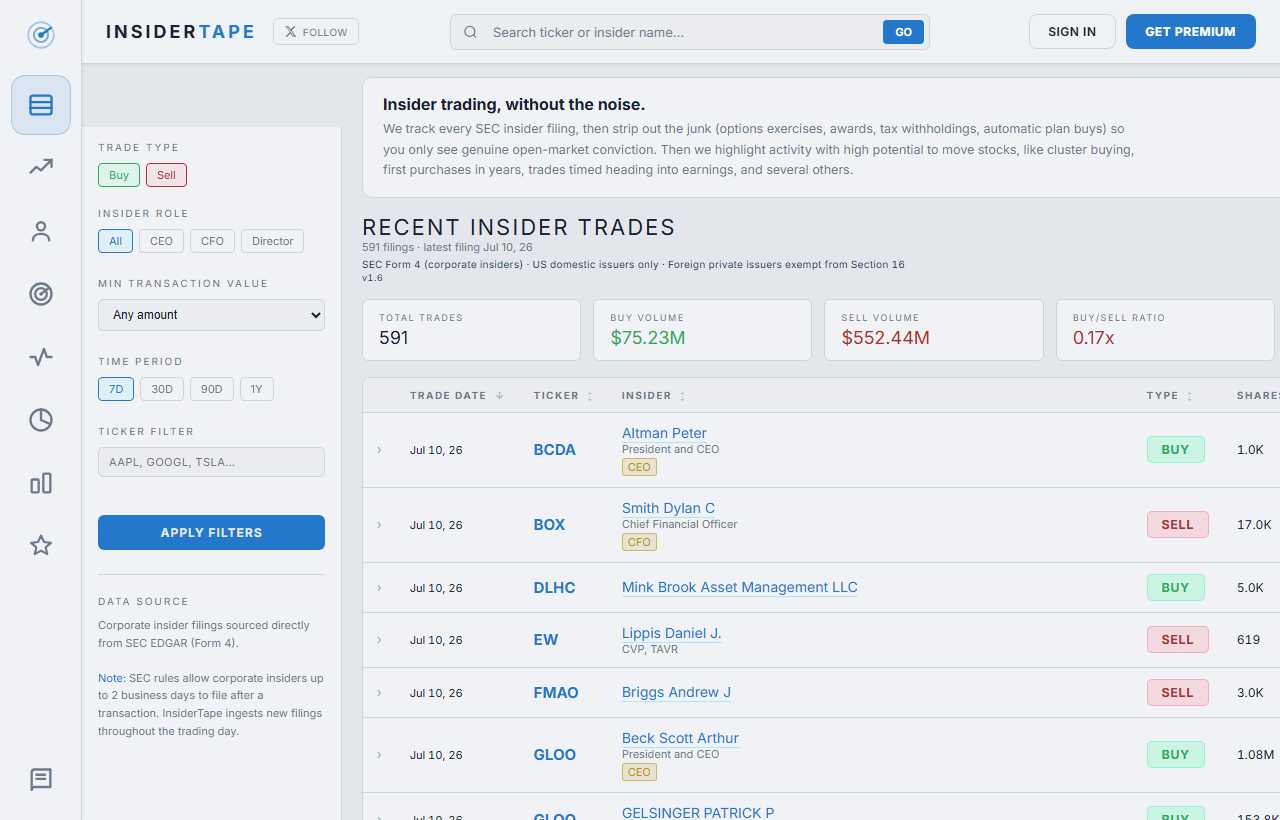
InsiderTape tracks every SEC Form 4 in real time, filters out the noise, and surfaces the buys that actually carry a signal: cluster buys, C-suite conviction, first buys in years, and purchases near the lows.
START FREE TRIAL →